
How to Automate AI Video Creation in 2026
The system used by creators who publish every day without spending all day on it: idea, script, visuals, voice, editing — all automated in 5 to 15 minutes.
Creating content takes time. Finding an idea, writing, editing, publishing… and starting over tomorrow. The problem isn't creativity. It's consistency.
Today, the creators winning on TikTok, YouTube, and Instagram aren't necessarily the most talented. They're the ones who publish the most. And to do that, they've stopped trying to do everything by hand.
Why automation changes everything
Automating isn't "cheating." It's optimizing.
- you save time
- you produce more
- you test more ideas
On today's platforms, the rule is simple: the more you publish, the more chances you have to break through. A video can get 1,000 views, the next one 10,000. And another… 1 million. But you have to publish in the first place.
How AI video automation works
A video is always built the same way:
- an idea
- a script
- visuals
- a voice
- an edit
Vidrale is designed to generate your videos automatically from your idea, running every step inside a single environment — no juggling between tools.
The full system in 5 steps
1. Generate ideas
Tap into trends, proven formats, and repeatable concepts. This is the foundation of a volume strategy: you never start from a blank page.
2. Write the script automatically
Turn an idea into a clear structure with a hook, a development, and a payoff. The script is what holds the viewer's attention — and it's often the most time-consuming step when done manually.
3. Generate the visuals
Images, animations, or AI videos tailored to the format. Vidrale lets you use different AI models depending on your need: a fast model to iterate, a heavier model for premium output.
4. Add a voice
Voiceover generated automatically, matched to the rhythm of the video. No more recording, editing, or cleaning up audio.
5. Automatic editing
Assemble everything without spending hours inside complex editing software. Editing is the step that blocks consistency the most — automating it unlocks your publishing rhythm.
Concrete example: how many videos per month?
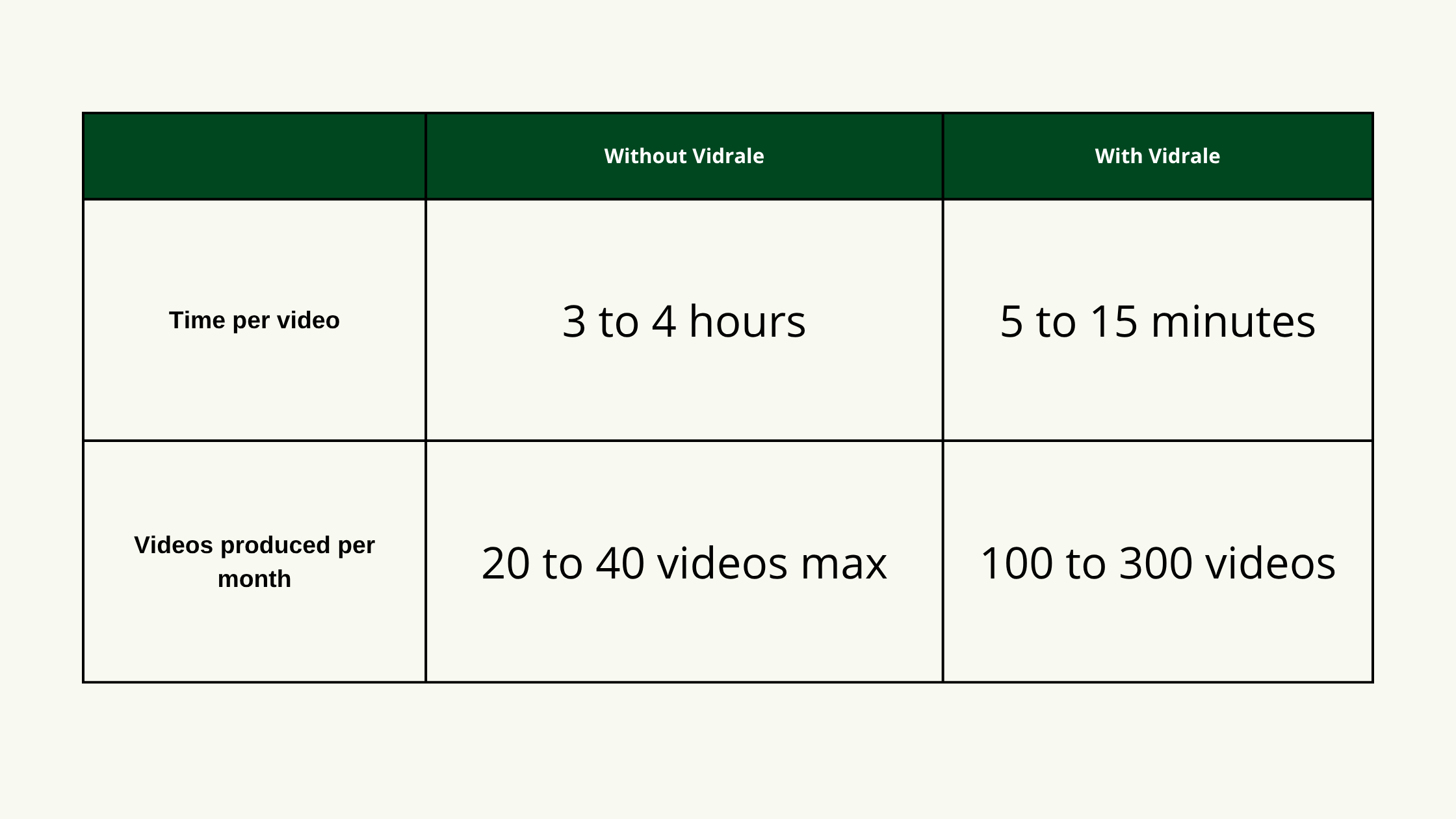
Without a centralized system, a creator has to handle every step manually or with several tools: idea, script, visuals, voice, editing. A single video can easily take 3 to 4 hours to produce. Over a month, that generally adds up to 20 to 40 videos maximum, with a heavy workload that's hard to sustain.
With an automated approach via Vidrale, the process is centralized and accelerated. A video can be produced in 5 to 15 minutes, because every step is already integrated. Over a month, that means creating 100 to 300 videos, without multiplying tools or subscriptions.
The difference is massive:
- less time per video
- more content published
- far more chances to generate views, audience, and opportunities
FAQ
Can you really automate your videos?
Yes, for the most part. The idea isn't to remove humans entirely, but to minimize repetitive tasks so you can focus on concept and strategy. The creator keeps control over angle, positioning, and editorial choices — automation takes over execution.
Does it really work on TikTok and YouTube?
Yes. Many accounts today generate millions of views with automated content, especially on TikTok and YouTube Shorts. The key is consistency: publishing every day (or even multiple times a day) is far more effective than putting out one perfect video every two weeks.
Do you need multiple tools to automate?
You can, but it's inefficient. Multiplying tools complicates the workflow, raises costs (4 to 5 subscriptions), and makes volume production nearly impossible. Centralizing into a single environment like Vidrale removes that friction.
What's the best solution to automate video creation?
The best approach is centralizing the whole process in a single system. Platforms like Vidrale let you create, assemble, and publish videos quickly while using several AI models without complexity. You keep the flexibility to pick the right model for each need, without managing parallel subscriptions.
How many videos can you produce per month by automating?
With an automated workflow, 100 to 300 videos per month is realistic for a solo creator — versus 20 to 40 manually. This volume lets you test formats at scale, identify what works, and capitalize on the videos that break through.