How to Go Viral on Social Media: The Real Mechanics of Virality in 2026
Virality isn't an accident. It's a mechanical, psychological, and structural phenomenon. Understand the 3 forces — retention, emotion, sharing — that trigger algorithmic amplification in 2026.
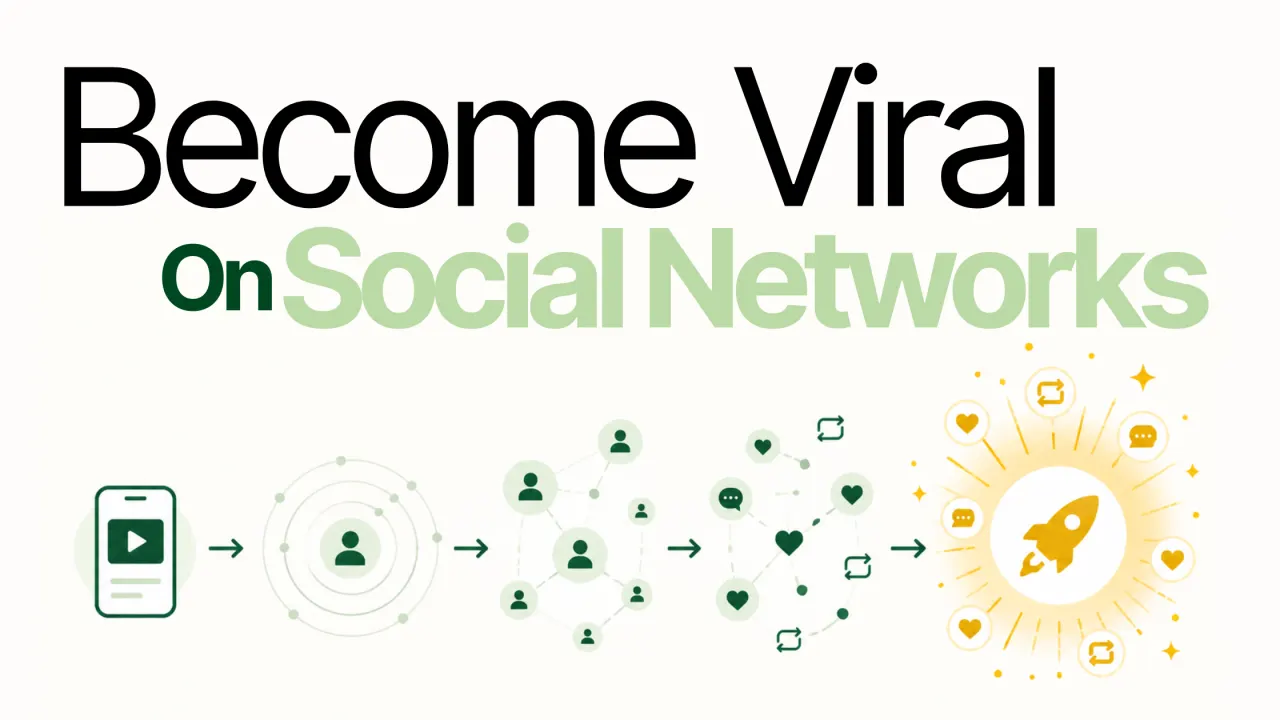
Virality isn't an accident.
It's a mechanical, psychological, and structural phenomenon. Before chasing virality, you need to understand what the word really means.
Virality isn't "getting a lot of views". Virality is an algorithmic amplification phenomenon triggered by massive human behavior. And that behavior rests on three forces: retention, emotion, sharing. When these three line up, the algorithm amplifies.
What triggers virality
Virality always starts with immediate attention.
On short-form, you have a critical window of 1 to 3 seconds to capture the gaze before the user scrolls. This first decisive phase rests on three fundamental pillars:
- A pattern break — an element that breaks the viewer's expectations and stops the scroll.
- A clear promise — an instant signal of the value the video will deliver.
- An open tension — an irresistible mental loop the viewer feels the need to close.
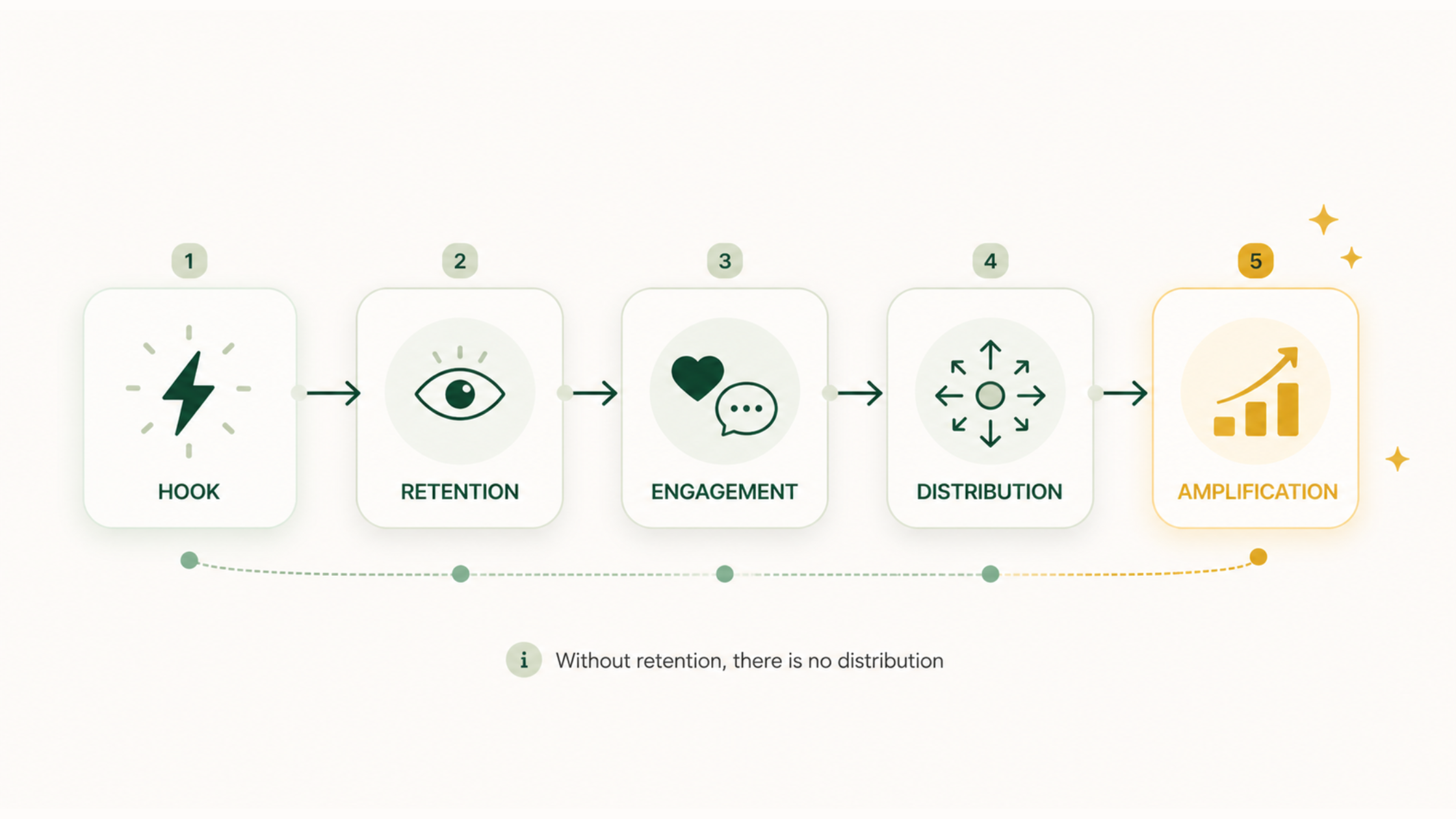
But capturing attention is only the first step. To trigger algorithmic amplification, you have to hold that attention throughout the video. It's the global retention that determines whether your content gets pushed massively or stays invisible.
Retention: the invisible heart of virality
Retention is the most decisive metric in the algorithmic distribution of a piece of content.
Most creators think virality comes from the topic, the production quality, or even luck. In reality, it comes from narrative structure.
A viral video isn't just interesting. It's built to maintain constant psychological tension from start to finish, preventing the viewer from leaving before the full resolution.
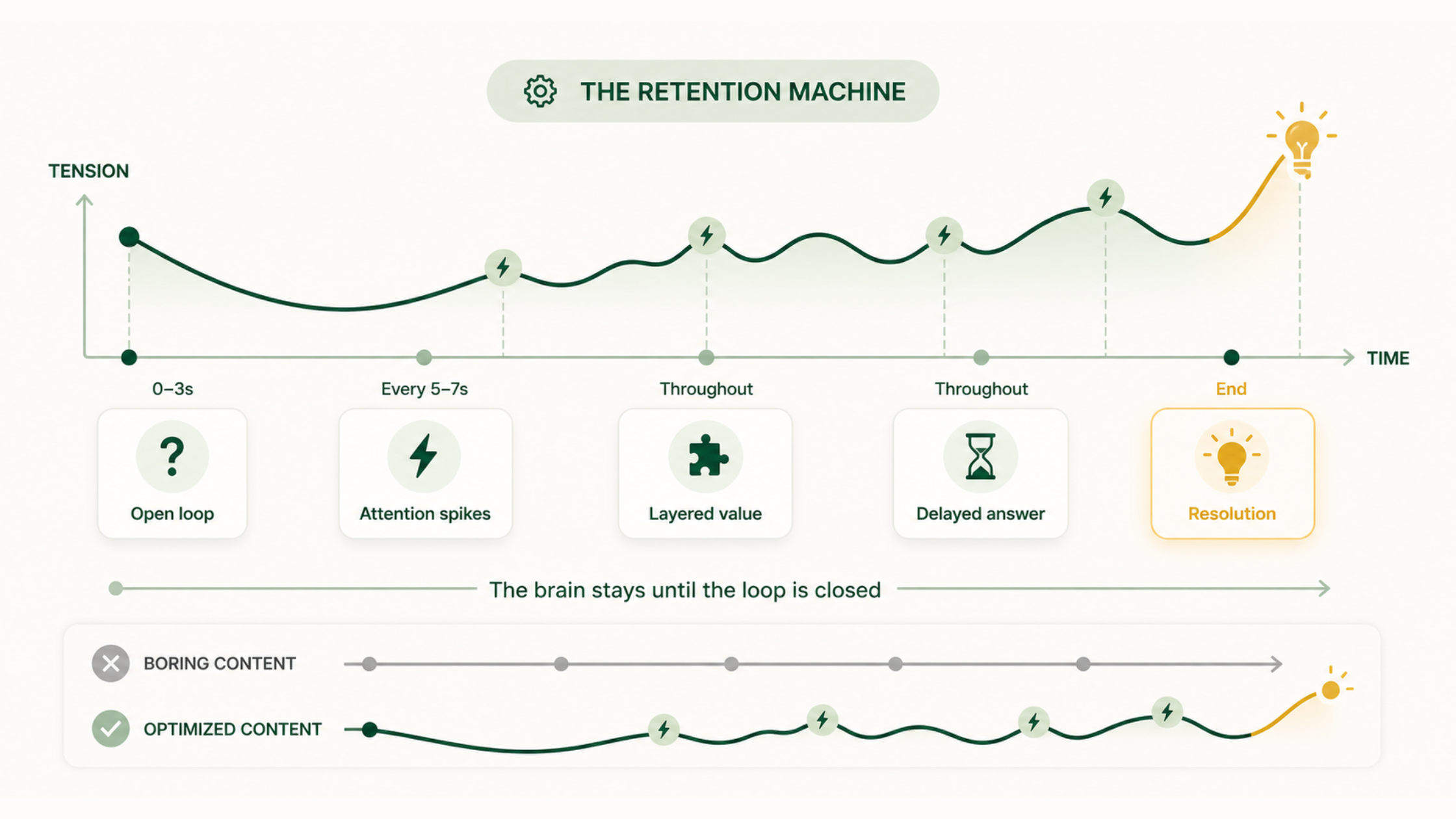
This tension relies on precise psychological mechanisms you can program into your content:
Retention mechanisms to integrate
- Progressive suspense — Build a dramatic climb where each segment adds a layer of information that intensifies anticipation. The resolution only lands at the very end, forcing the viewer to stay until the end to get the answer.
- Delayed promise — Announce up front what the viewer is going to get, but strategically delay delivery. This technique creates an open mental loop the brain actively wants to close.
- Final reveal — Structure the content as a journey toward an unexpected discovery. Each step has to deliver just enough value to keep interest alive while saving the surprise for the conclusion.
- Open question — Pose an explicit or implicit question at the start, then build the answer gradually. The viewer stays engaged because they actively want to know the answer.
- Micro-cliffhangers — Plant small moments of tension at regular intervals (every 5–7 seconds) to re-spike attention each time it's about to dip.
- Layered structure — Reveal information in successive steps where each new piece makes the previous one even more interesting. This accumulation reinforces engagement.
Concretely, this means:
- Never reveal everything in the hook — create a clear but incomplete promise.
- Keep at least one open question alive at every moment of the video.
- Structure content as a logical progression toward a satisfying resolution.
- Avoid dead air where no new information is added.
- End on a note that delivers a clear conclusion to the initial promise.
Retention isn't a talent or luck question. It's a question of intentional narrative architecture.
Emotion: the neurological trigger for sharing
If retention determines whether your content gets watched, emotion determines whether it gets shared.
Content that explodes isn't just informative or entertaining. It triggers an emotional reaction intense enough that the viewer feels the visceral need to share what they just saw.
This sharing isn't rational. It's emotional.
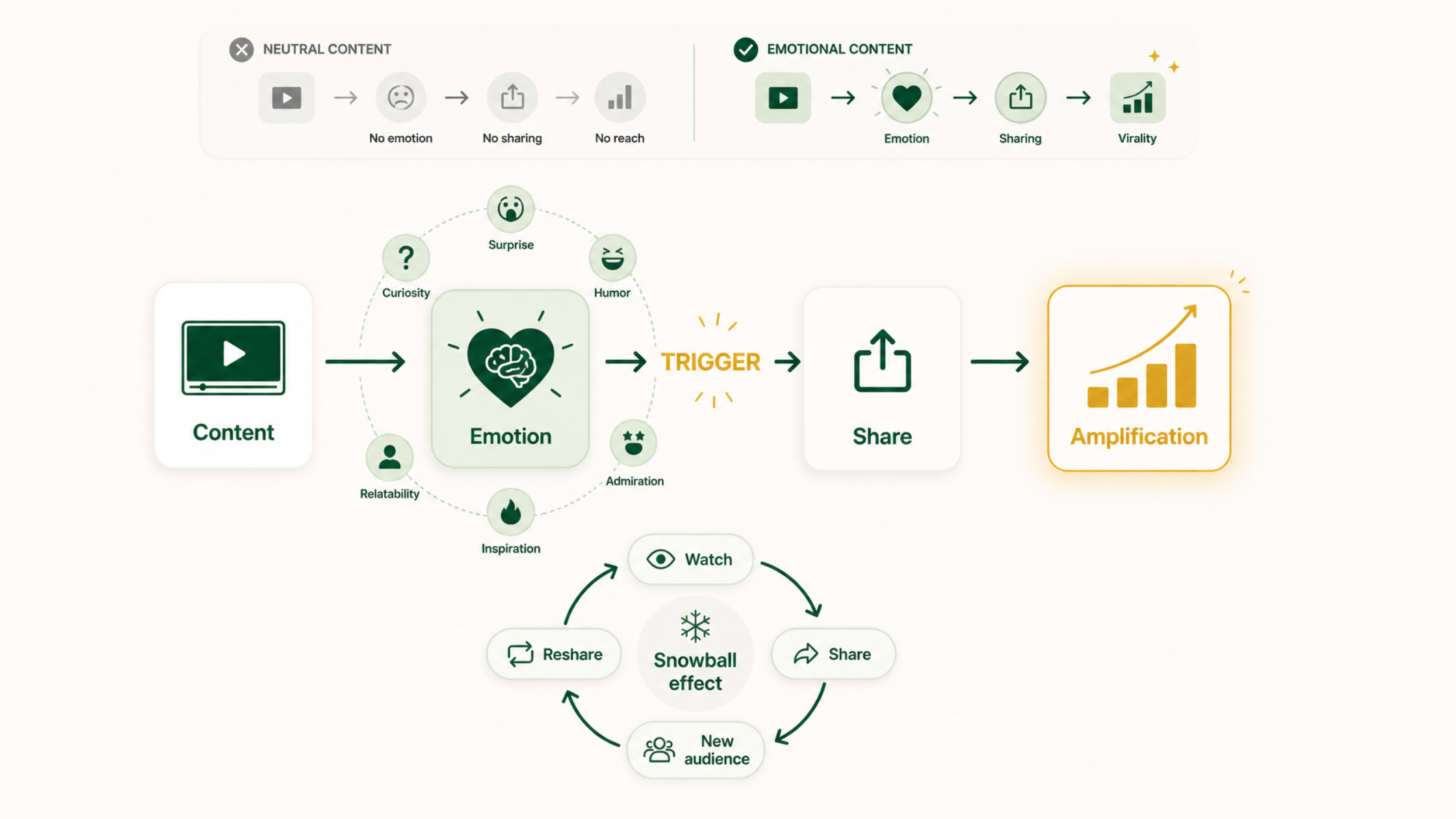
The viral emotions to program
| Emotion | Mechanism | Hook example |
|---|---|---|
| Surprise | Unexpected twist, counter-intuitive reveal | "Here's what nobody tells you about…" |
| Admiration | Exceptional skill, extraordinary result | Spectacular transformations, mastery demos |
| Outrage | Hidden truth exposed, injustice revealed | "Here's what brands are hiding from you…" |
| Humor | Absurdity, satire, comic contrast | The most-shared emotion on social media |
| Identification | Universal experience perfectly articulated | "That's literally me" |
| Inspiration | Story of overcoming, aspirational vision | Emotional elevation people want to pass on |
| Intense curiosity | Fascinating question, captivating mystery | Promise of discovery |
The more intense the emotion, the more likely the content gets shared. And sharing is the real multiplier of virality.
Here's why: the algorithm observes not just retention, but also the share rate. Shared content signals to the platform that it has enough social value to actively recommend to other users.
Sharing triggers an amplification loop:
- A viewer watches and shares.
- Their network discovers the content.
- Part of that network shares in turn.
- The algorithm detects this mass-sharing behavior.
- It amplifies distribution to cold audiences (non-followers).
- The cycle repeats at exponential scale.
The concrete results of virality
A lot of creators assume virality = lasting growth. That's not always true.
Virality can produce:
- A massive visibility spike.
- A burst of new followers in a few days.
- Sudden exposure to brand-new audiences.
But if it isn't aligned with your positioning, it can also produce:
- A poorly qualified audience that doesn't consume your other content.
- A dilution of your identity if you start endlessly reproducing the format.
- Pressure to reproduce a success you can't rationally explain.
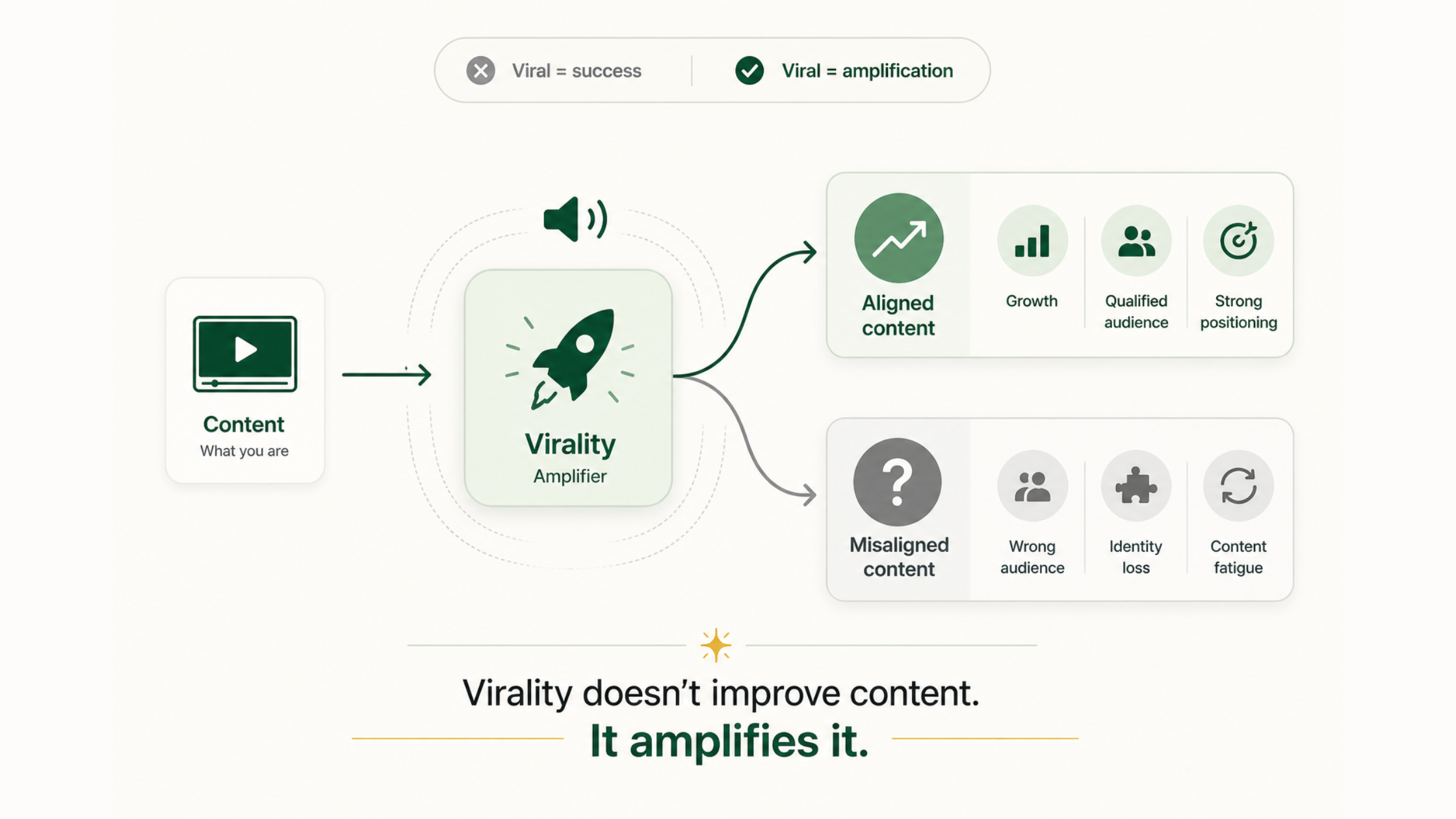
Virality is an accelerator. It amplifies what you already are — the good and the bad. If your positioning is clear and your offer is ready, it pushes you up a tier. If not, it can burn you.
That's exactly why we often say build the machine before chasing virality. The full method for producing at volume with a centralized AI workflow is broken down in How to Automate AI Video Creation in 2026.
Structures that increase the probability of virality
There's no magic formula, but there are proven structures that maximize the odds.
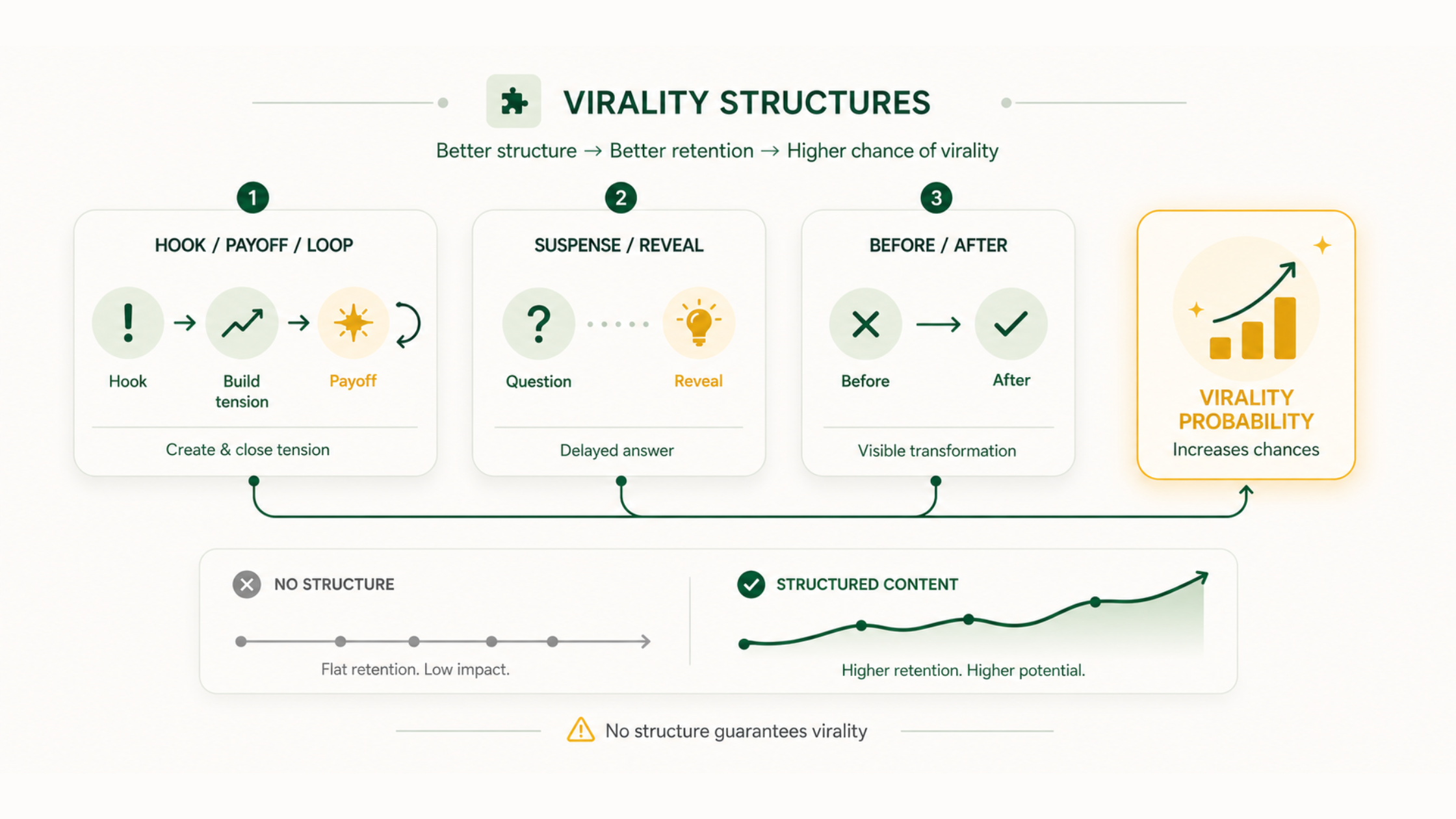
Hook → Payoff → Loop
The most effective one. You open a tension in the first 2 seconds, you build progressively toward a payoff, and you close the loop at the end — ideally with a visual or narrative callback to the opening, which drives rewatches.
Suspense reveal
The answer is delivered gradually, not immediately. At each step, you give just enough information to keep interest alive without revealing everything. Full disclosure only happens at the end.
Before / After
Powerful because it shows a visible transformation. The human brain is wired to stop on sharp contrasts. It's one of the most effective structures for tutorial, fitness, business, or product UGC content.
FAQ
How do you go viral on social media?
Virality rests on the alignment of 3 forces: retention (holding attention end-to-end), emotion (triggering a reaction strong enough to drive sharing), and sharing itself (which signals strong social value to the algorithm). Programming these 3 elements into every video significantly increases the probability of virality. No method guarantees virality — but a sound architecture makes it statistically reproducible at volume.
Why do some videos go viral and others don't?
Because the algorithm distributes content in successive tiers. A video is first shown to 200–500 people; if retention, completion, and share rate clear a threshold, it moves up a tier (5,000, then 50,000, then 500,000…). Viral videos are the ones that clear every tier thanks to a tight narrative architecture, a strong programmed emotion, and a structure that drives rewatches or sharing.
What's the difference between virality and growth?
Virality is a one-off spike in visibility — it gets you views and followers fast, but it doesn't build anything on its own. Growth is a system: clear positioning, regular content, a qualified audience that comes back. Virality can accelerate growth, but only if it's aligned with your positioning. Otherwise, it brings a poorly qualified audience that won't consume your other content.
How long does it take to go viral?
There's no guaranteed timeline. Some creators explode on their 5th video, others after 200. What's observable: creators who rigorously apply the principles of retention, emotion, and structure at volume (3 to 5 videos per day) statistically hit their first viral spike between 30 and 90 days. Below one video per day, you give too little data for the algorithm to optimize you and too few shots for the law of large numbers to play.
Should you aim for virality or sustained growth?
The two aren't opposed, but order matters. Virality without a system burns the audience. Sustained growth without a spike plateaus. The best strategy: first build a regular production machine (clear positioning, reproducible format, centralized workflow), then aim for virality by applying Hook → Payoff → Loop, suspense reveal, and before/after structures at volume. Virality then becomes an accelerator, not a lucky strike.
Can AI actually help me go viral?
AI doesn't make a piece of content viral — it lets you test at scale. You can generate 20 variations of the same hook, 15 different angles on one topic, 10 narrative structures on the same idea. The algorithm then finds the one that converts. AI's role isn't to replace creativity — it's to multiply by 20 the number of tests you can run per week. The full workflow is broken down in How to Automate AI Video Creation in 2026.